

If you’ve ever worked in a chemistry lab, you’re probably used to taking solvents for granted—grab the right one off the shelf, run your reaction or analysis, and pour it in the flammable waste when you’re done. Recently, we’ve started to question whether we can use solvents more sustainably. Many common solvents are hazardous petrochemicals, creating a big environmental footprint problem as well as putting workers at risk. So what can we do?
What is a solvent?
First, as always, we need some definitions. It might seem obvious what a solvent is – the liquid bit! – but the answer becomes less clear when using supercritical fluids, gaseous solvents, or reactive solvents that become part of the product.
A solvent can be defined most simply as one component of a solution, but the more familiar definition is a substance that is used to dissolve your target substance (solute). Solvents have found widespread use in most industries, playing key roles in manufacturing processes, coatings, adhesives, and cleaning products. They’re also critical in chemistry research, making reactions easier, more efficient, and often safer. Consequently, demand for solvents has grown to the order of 20 million metric tonnes per annum, and is worth tens of billions of US dollars to the global economy.
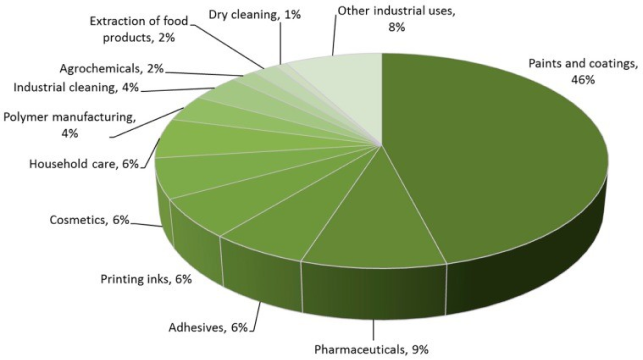
Solvent use by sector as reported by Clarke et al. Image source.
The widespread usage of solvents, and their tendency to be thrown away after one use, has made them an obvious target in improving the sustainability of the chemical industry. This is particularly important in the pharmaceutical industry, where research from GlaxoSmithKline (GSK) has shown that in the synthesis of a typical active pharmaceutical ingredient, solvent can account for as much 80–90% of the total waste by mass. Reducing solvent consumption or switching to green solvents can greatly improve process sustainability in almost any industry.
What’s a green solvent?
The growing interest in environmental preservation and responsible use of resources, along with increasing pressure to reduce the use of harmful chemicals (see the United Nations Sustainable Development Goals, REACH, or the SIN List), is boosting demand for innovative solutions to the solvent problem. Green chemistry, a practice that seeks to design safer, more sustainable chemical products and processes, highlights safer solvents and auxiliaries as one of its 12 Principles of Green Chemistry. So, what exactly are green solvents and how can we go about finding sustainable alternatives to conventional solvents?
As always in sustainable science, pinning down an exact definition of “green” is challenging, and depends on the intended use. A solvent that evaporates slowly would be considered less green in pharmaceutical manufacturing, as more energy would be needed to remove the solvent from the target product. But in a fragrance diffuser formulation, slower evaporation can make the product last longer, reducing resource use as the product needs to be replaced less frequently.
For a solvent to be green, its negative impact on environmental and human health must be minimised. However, a full understanding of environmental impact requires an assessment of the solvent’s impact from manufacture to disposal, more commonly known as a life-cycle assessment (LCA). This sort of data is hard to come by, and often tailored to very specific applications. In practice, it is more realistic to assess solvents on key properties for which data is available. These could be factors such as the hazard labels (flammability, aquatic toxicity, etc.), physical properties (such as boiling point, viscosity, density), the percentage of biobased feedstock, or cost. Finally, the performance of the solvent is critical to consider as part of the green definition—adopting a biobased solvent with a 30% lower carbon footprint is not sustainable if the substitution requires using 80% more solvent.
Choosing a green solvent
It’s become clear that selecting a green solvent that works for your product or process can be incredibly complicated. What practical steps can you take when considering a sustainable substitution?
Skip the solvent
The first option to consider is if an organic solvent (the conventional chemical option) is even needed in the first place. Companies in the paints, inks and adhesives industries have historically relied on large quantities of volatile organic compounds (VOCs) as solvents in their formulations. However, stricter legislation limiting the use of VOCs has led to a wealth of innovation in water-based formulations and solvent-free technologies, including powder coating and high-energy curing.
In chemical synthesis, mechanochemistry has emerged as a promising solvent-free approach. Instead of dissolving reagents in a solvent to mix them, solid materials are ground together with little or no liquid, and chemical transformations are facilitated through the input of mechanical energy. This technique is still in early research stages and has yet to see widespread adoption, although there is growing industrial interest, particularly in the preparation of metal-organic frameworks (MOFs) for applications such as gas-storage and CO2-capture.
Try a solvent selection guide
However, if solvents are crucial to your industry, there are a few tools you can use to help you pick an alternative. One of the simplest approaches, which has attracted a lot of academic debate recently, is a solvent selection guide. These guides are developed by academic or industrial chemists who compare solvents across a range of properties and suggest possible greener alternatives for commonly used solvents.